

23 min read
What This Episode is About
Aubrey Zeitner shares her journey from teaching English during the height of COVID to becoming a field marketing manager at Brisk, highlighting the pivotal decision—and one mentor—who completely changed her career trajectory. She reflects on the unconventional ways pandemic teaching shaped her practice, the burnout she faced, and the deep desire to stay connected to educators even after leaving the classroom. Aubrey discusses how AI, when created thoughtfully by educators, can restore humanity and connection rather than replace it. She also offers empowering guidance for teachers at every stage—reminding them that their skills are extraordinary and that they deserve to create new opportunities for themselves.
Meet Our Guest
Aubrey is a former middle and high school English educator and a graduate of the University of Texas who transitioned into Edtech, bringing classroom experience into marketing and growth roles. She previously served as General Marketing Manager at Propello, an inquiry-based science learning platform, and now works at Brisk, the #1 AI platform for education
Key Takeaways
- The skills educators develop—adaptability, communication, problem-solving—make them exceptionally competitive candidates for roles beyond the classroom, even without formal experience in those fields.
- Aubrey originally turned down the internship that became her gateway into EdTech, only to have the hiring manager reach back out a month later with a flexible offer that changed her entire career trajectory.
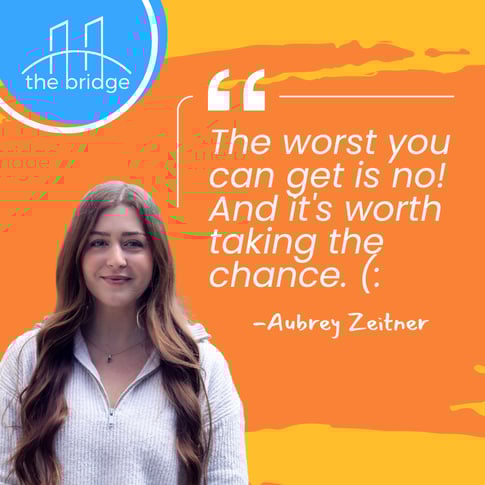
- Don’t wait for someone to create opportunities for you—reach out, pitch yourself, and initiate conversations. The worst you’ll hear is “no,” but the best outcome might alter your whole path.
- One person believing in you can truly transform your journey; mentorship, connection, and shared experiences can open doors and help educators reimagine what “belonging in education” looks like, both inside and outside the classroom.
Resources & Mentions
Transcript
Cate Tolnai (she/her): Welcome, Aubrey to The Bridge. so great to have you here. I, I, I'm excited. We have, we have the most lovely human in common , Ann Kozma and, and she as, as she's done with so many people on The Bridge, she has helped bring our worlds. She's helped bridge all of us together, and so
Aubrey Zeitner: she always does. Yeah. She's a bridge herself. Yeah.
Cate Tolnai (she/her): is that like, it should just be her face. But, Aubrey, go ahead and introduce yourself and like tell us a little bit about where you're at and what you do and yeah.
Aubrey Zeitner: Sure. I'd love to. I'm so happy to be here. Thank you for having me. thanks to Anne for being this beautiful beacon of connectivity in the EdTech space and beyond. I guess it's probably redundant to say my name. I'll say it anyways. My name's Aubrey. I have, done a lot of things. I been a lot of places in my, in my past life that feels very long ago.
I was, I was a middle school and high school English teacher, since have transitioned into ed Tech. And I'm currently with Brisk, which is a, a widely used and widely loved, ed tech tool. Yeah, it's a great, it's a great, great tool. I'm so fortunate. and, and happy to, to be there and get to, to, you know, push forward this amazing time saving.
Platform for teachers and educators, something that I deeply wish I would've had access to when I was grading 200 papers every other week. at Brisk, in particular, I am our field marketing manager. So anytime that you, see Brisk at a conference or an event, or a party, any anyways that you see us show up and engage with the community and engage in person, I'm usually the person that's behind that.
which is super fun because. What an amazing way to get to bridge, the gap between education and teachers, in a way that, that brings us together in common spaces and, and creates community and conversation. So, I love that and I'm so grateful to get to do that on a daily basis. I
Cate Tolnai (she/her): well, like you do it with such
Aubrey Zeitner: thank you.
Cate Tolnai (she/her): like I, I, I. I wanna know how you unlock that for yourself. Like how do you go from being a high school English teacher to like marketing for Ned Tech company? How interesting.
Aubrey Zeitner: Yeah. wow. So funny. It's funny to reflect on that because I think it's such a great reminder that life can change very quickly, very drastically, and you never know what's on the other side.
Cate Tolnai (she/her): Yeah.
Aubrey Zeitner: and it's just very few. There's like moments that are catalyst decisions that you make that change your life entirely, and then you reflect back on it and you can pinpoint it back to one moment and say, wow, if I did not make that decision, my life wouldn't be what it is right now.
And that's very much what it was for me. So I had been in the classroom for a few years. My first year of teaching was in COVID, so that was a very hard Yeah. Yep. Very first. I'm talking like my student teaching semester was the semester that COVID started. So I actually was one of the, the student teachers whose semester ended early.
We were all given, our certifications without completing those final few hours because all the schools had shut down and that meant that I was interviewing for jobs as COVID was at. Its. Peak, the world was shut down. Masks were everywhere. That was when I was doing my interviews and my very first.
Cate Tolnai (she/her): if you're like, I
Aubrey Zeitner: You did?
Yes. Yeah. Right. And then my very first year as a, a true like teacher of record, so World Shuts down in March. My student teaching ended. I started interviewing for jobs in June and then I took my first, my first role at a middle school in Lake Travis, Texas, and started in August. And that was when everyone started that school year virtual.
so could not have asked for a more unconventional way to come into education and to learn to adapt.
Cate Tolnai (she/her): ask like, were you ready? Like, did you feel like you wanted to do online learning? Like, or were you like, I guess this is what the world's doing? Like I, I don't know how I'm, that's a dumb question because I
Aubrey Zeitner: Yeah.
Cate Tolnai (she/her): oh, what the hell? Like, like I want in person, but there's a part of me that wonders like being your first. Gig, like were you like, okay, this is how it's gonna happen, or
Aubrey Zeitner: Totally. Yeah, it was super weird. It's so weird. I reflect back on it now and like I had very, I had exposure to a normal classroom. I had done teaching for three years prior. I had, I had been with a cooperating teacher for many years. Like I had experienced that. But as the first time as a teacher of record, absolutely.
It was such a strange way to adapt to learning. It was, to some degree, there were positives to it, which was that I almost felt less like I was coming into an environment as someone who was new and knew nothing because everybody at that time was adapting to something that was new. So to some degree, it almost felt a little bit like I had a stronger community from the start because we were all in it together.
But I do look back on it now and it's so strange because I see the ways that that experience shaped my teaching in, in really strange ways that I think would only be possible for somebody whose first encounter being a teacher was in that capacity. So, like for example, when I first started teaching and we were doing virtual learning, they had built cubbies around our desks and, it started virtual, but.
By the first month we had gone back in person, but with a lot of regulation, so we were all wearing masks in the classroom. Everyone had to wipe. At their desk when they came in and wiped their desk when they left, and the teachers had built in cubbies around and we had to teach from our desk. And we were also teaching to students in a hybrid capacity.
So I had some students who were in my classroom. I had some students who were online, which meant I had to teach from my desk. I had to teach in front of a computer, so that my online students had access to me and my in-person students had access to me and what I learned after all of that was over, I did not feel comfortable.
By my third year of teaching, second, maybe somewhere in the middle of my second year, I didn't feel comfortable standing at the front of a classroom, which is such a like standard practice for teachers because for two years I had been used to. Standing in the back. And so my comfort space, the place where I grew and learned to teach and like became comfortable being was at the back of the room.
and so like that was one of those weird ways where I was like, anyone who had the founda foundational experience prior, where they were like for the last 10 years, they stood at the front of the room and taught to the class. Like wouldn't have experienced that. But for me, that's all I had experienced.
It was just a super. Super weird environment to go into. Of course, I adapted beyond that when we went back to traditional teaching. But yeah, super, super strange environment.
Cate Tolnai (she/her): have shaped like, shapes your, that shapes your approach to education like a million percent. Because if you're in the back,
Aubrey Zeitner: Yeah.
Cate Tolnai (she/her): steering the ship. You're letting, I mean, did you find that, like were the kids guiding the ship more than you were, or,
Aubrey Zeitner: No, no, actually I just found it was like one of those weird, Weird, just like changes to the setup where it was strange. The back of the room just became the front of the room. So to some degree, like I was standing at the front of the classroom, but our front of the classroom became the back of the classroom.
It didn't help that I had like smart boards on either side. but yeah, it just like all the students turned to the back and I stood at the back and I was at that board instead of this board. And yeah, it was just a weird.
Cate Tolnai (she/her): it kind of like takes our whole traditional approach to the classroom and be, and it's like actually there, what if there is no front? What if we're just all together?
Aubrey Zeitner: Yeah, I had actually, I had boards on all sides of my room except for one, so I always found I gravitated to the backboard and the sideboard, but never the front board.
Cate Tolnai (she/her): funny. And you and, okay, so
Aubrey Zeitner: Yeah.
Cate Tolnai (she/her): you moved into this ed tech space soon after that, so, okay. So tell us how you went there.
Aubrey Zeitner: Yeah. So I guess to kind of full circle what I was saying earlier about these like pivotal moments and decisions that really changed the trajectory of your path. I had decided after four years that I wanted to make the move. I always felt this like very strong desire and calling towards marketing.
I knew very little about it at the time, but I don't know if like anyone out there has ever had a moment where they've just been like, I think I meant to do this. I think that's what. Is meant for me. Yeah, of course. Like these, you don't have the context and you don't know fully the gravity of the choice, but you just feel a calling towards something and that's, that's very much how I felt.
And, I started applying for jobs. I was qualified to some degree in ed tech with my teaching background, but I didn't have any marketing experience. And there was a role that had posted for. it was an internship at a, at a, science-based, inquiry-based learning science platform, and it was for a marketing intern, which meant of course, as someone who was four years deep in their career.
This was actually quite, quite a drastic shift because I was going from someone who had the retirement account and full benefits and a salary to an intern, a part-time intern at that actually. And I think there's always been an innate part of myself that was willing to take risks. And so at that time, I felt willing to take the risk.
I knew who I was, I knew what I could offer. And my thought process at at that time was if I could just get in the door in two months, they'll, they'll offer me the job and I'll just.
Cate Tolnai (she/her): that.
Aubrey Zeitner: Take the, the pay cut and I'll make it work.
Cate Tolnai (she/her): Wow.
Aubrey Zeitner: and that was a gamble. I've done that a few times in my life where I've had these gambles where I've just said, well, I just know what's gonna happen, so I'm gonna take the risk.
I think maybe because sometimes my brain told me it wasn't a risk because I knew what the outcome would be, even though in reality I had no idea what the outcome would be.
Cate Tolnai (she/her): Well, it's
What's the alternative? Like, you're not gonna be successful, like absolutely not.
Aubrey Zeitner: totally.
Cate Tolnai (she/her): Got
Aubrey Zeitner: Totally. Yeah. So I interviewed for the role and I, and I was offered the job, and then I actually said no. turned it down. This was in February. I interviewed for the role on Valentine's Day. I'll, I'll actually never forget, and I remember. Really deeply connecting with, with the person that I was interviewing who actually became a, a huge mentor in my life.
And I remember walking outta my classroom. I took the interview in my classroom on my off period, and I remember walking out to the, my teacher friend across the hallway and being like, ah, I think I'm gonna get that job. And I was stressed about it. And lo and behold, a week later she offered me the job.
This was the beginning of March. I accepted and then about a week later I turned it down, fully removed myself. because the transition outta the classroom at that time was gonna be really hard. As you know, if you leave during your contract, the likelihood that you leave your license is really lose.
Your license is really high. so not only was. Was I gonna forsake my benefits and, and forsake all of these things, but I was gonna forsake it in a way that also took away this piece of paper that I had worked really hard for. And so I said no. And I felt a lot of relief in that moment when I said no.
And I went back to teaching and continued to think that at some point I would leave, but that time wasn't now. And then on spring break, about a month later. I got a text from, from, from that person who has become a mentor who, who was turn ended up becoming my VP of marketing and she texted me and she was like, Hey, I just, you know, it's been a month.
I've interviewed some more people. I really haven't felt excited about them. If it makes sense, we could have a conversation about delaying your start date. You could finish out the year. And immediately I was like, yes. Hundred percent because then I leave, I don't lose my license. And I was just so grateful that she thought of me and did that and was willing to accommodate the schedule.
And so then I, I did end up leaving in May of that year. I didn't resign my contract. and I transitioned straight from teaching was the final day, like May 15th, and I went straight. Straight into this new role and that role became
Cate Tolnai (she/her): Aubrey, because like, the flexibility, like be you, just you, you hope for that. You hope for the.
Aubrey Zeitner: absolutely.
Cate Tolnai (she/her): The corporate side to have that understanding that like they, under, they, they know what they're getting in an educator, like the skills are
Aubrey Zeitner: Totally.
Cate Tolnai (she/her): you just like, we are constrained and nobody, just, the fact that they were like, we don't want you to feel compromised in any way, shape, or form.
That speaks volumes.
Aubrey Zeitner: Yeah. Absolutely. Absolutely. And it was only a testament to what I would continue to experience, especially under the guidance and the, and the mentorship of, of this particular person. But, yeah, I ended up being in that role for close to a year and a half and was able to experience excelling in ways that I don't always feel exist in the world of education.
Cate Tolnai (she/her): more about
Aubrey Zeitner: and then.
Cate Tolnai (she/her): what were you excelling
Aubrey Zeitner: Yeah, totally. Just, you know, growing and, and changing titles, experiencing raises, like these things don't exist in corporate in a way that can be super validating when you're experiencing it to feel like you're. Growing and, and climbing. I don't always feel like that feels possible. And actually to some degree, objectively isn't possible.
in the world of education, there's very few paths. Yeah, of course. Yeah. It's like you can be a teacher, there's very little room for growth there. If you wanna move up or climb. Your paths are like coaching or administration and, and beyond that, you're quite limited. and so the growth in that role took me all the way through.
Joining Brisk, which has just been the craziest whirlwind, to be in a startup capacity that is like exceptionally high growth, a tool that has an exceptional amount of affinity around it that is widely loved and, and, and, and widely used is. Has been the largest learning moment of my life. And sometimes I sit and I reflect, like I said, to bring all the way back to the, to the beginning, which is that I did say no.
I had fully said no. I had fully removed myself. And if it wouldn't have been for that one specific person who came back and said, I see something in you. I'm willing to take a chance on you. Let's talk about how we can make it happen. It was that exact moment in my life. That exact person that opened the door for what, what my life is now, which is, I couldn't have dreamed it four years ago if someone had told me that I'd be doing now what I am, I wouldn't have believed them.
And yeah, I don't know. Sometimes, sometimes it makes me almost sick to be like, but I, I let go of it. Like everything that I have now, I wouldn't have, I said no. And if it wasn't for that person, I wouldn't, I wouldn't have any of it. Yeah.
Cate Tolnai (she/her): you that, that looks for opportunities to like pay it forward right now? Or are you, I mean there's also this part that's like a trick question 'cause of course you do. But like, are you even at that place where you could, you know, like that's
Aubrey Zeitner: Yeah,
Cate Tolnai (she/her): question is like, where are you at now and are you able
Aubrey Zeitner: course.
Cate Tolnai (she/her): are you able to, to pay it forward I should say?
Aubrey Zeitner: Of course. Yeah. I think, one of the unique things about my position is that I work fully remote and I work at a remote first company, but I am out in person all of the time. I am constantly on the road, constantly traveling, constantly at conferences, connecting with educators, and, I'm not shy about my story.
I connect with educators a lot. Who will ask me, they'll, they'll be in the booth and they'll be like, how did you get here? Anytime I make mention that I was a former teacher, the first question is like, how did you get here? How'd you do it? And I'm the first to, yeah, tell them the exact path that I took.
Call out the, like some bits of the story that are, a, a little bit weird or, or, unconventional and then. Give them all the resource resources that I possibly can give them. I'm like, connect with me on LinkedIn. Let me send you this page. This this person does a bunch of job postings for ed tech. Let me send you them.
I have so many dms in my, in my LinkedIn from educators that I've connected with at conferences, and sparked a conversation over this very, very thing. So, and anyways, that it's possible, of course, I wanna connect and, and have those conversations.
Cate Tolnai (she/her): I guess there's a part of me, oh, a big part of me that just. Wants to like hug teachers and just, I've said, I've said this entire journey through the bridge, like this is like my love letter to educators and like
Aubrey Zeitner: Yeah.
Cate Tolnai (she/her): like these kind of micro case studies of different ways of succeeding under the umbrella of education that it doesn't all have to look like a classroom teaching experience to still be able to give back to kids and give back to community and do all the advocacy that we as teachers do. And so how do you, I can't imagine you're sitting there as like the commercial for leaving the classroom. So like have you had conversations with teachers where they're feeling almost more invested in the classroom after talking to you?
Aubrey Zeitner: Oh my gosh. Absolutely. Especially right, I, the, the conversation is like slightly teed up for me and easy as I am usually having these conversations in the context of all the ways in which we're progressing and making education more accessible. I don't wanna say easier. I think that that is a really challenging term to use because I don't think that being a classroom teacher, and I don't think education will ever be easy, but the ways in which we are opening it up to be.
More accessible to give teachers time back to make their lives. More fueled and filled with connection in a way that they've never had time for before. I'm sort of at a crossroads where it's really easy to spark that conversation because I'm typically always promoting something that does that very thing.
So yes, of course. anytime that I'm connecting with educators in, in ways that are talking about how we can change the classroom for the better, how we can make it more. Centered around the human experience, more accessible, like the burden that teachers have on a, on a daily basis is immense. I remember my last year of teaching, I had 178 students on my roster, and I was teaching high school, right.
Or teaching English, which is one of the, the heaviest grading lifts of all the subjects.
Cate Tolnai (she/her): my first year girl. It is wild,
Aubrey Zeitner: a thousand percent wild. Yeah. And I had 85, 86, 87 students with IEPs, your five oh fours accommodations that I had to meet, and I quite literally felt like I was drowning. And then on top of it, you're having to create content and you're having to create lessons, and you're wanting to make sure that it's engaging.
And then you wanna make sure that you connect on a deep level with your students and that you're there for them as this po beacon of positivity who can help. Shape and change lives, which is like at its core what teaching is like meant. That's the powerhouse of teaching. And I had nothing, no resources, nothing to guide the way Chachi BT was not even a thing yet.
and yeah, I think some of the ways in which not to change teaching, not to take the human out of teaching, not to take the teacher out of teaching, but some of the ways in which we have resources at our disposal now that have taken great care, have been crafted by educators and taking great care to think about.
What it is to be a classroom teacher and to build tools and resources that elevate the teaching experience. They don't make it easier, but they elevate what it means to be a teacher and they help what it means to execute as a teacher. I'm just so grateful to be a part of that, and so I'm constantly talking to educators, about that very thing because you're right, so many, so many.
Educators were born to do this call, to do this and have no desire. Like they, they want to be there for their students. And so connecting on a deep level about actually how we can just help to assist in various ways is, a conversation that I never get tired of having. So I'm like having one of these two conversations.
I'm typically having conversations around resources on how you can like, persist on the journey of leaving education, if that's what you feel called to do, but also how you can really amplify. Your journey inside the classroom, if that's what you feel called to do. And I enjoy that. I get to have both of those conversations on a daily basis.
Cate Tolnai (she/her): Oh
Aubrey Zeitner: know.
Cate Tolnai (she/her): Well, and it makes me wonder too like, like how do you stay grounded in your own humanity when you're working in an ai at an AI startup?
Aubrey Zeitner: Yeah. Oh my gosh. I love this question. Okay, my hot take on this, my very, very hot take on this. Something that I think I've also gotten to amplify a lot at Brisk is that ai, especially AI designed explicitly for teachers, puts the human back in the classroom in a way that it never was before. So. Even myself being an educator who experienced burnout, who wanted to connect so deeply with my students, but sometimes didn't have the mental capacity, the physical capacity to do it.
Ai, I think really gives back in that way where the burnout and the load that teachers experience can help to be lifted so that the human component of teaching the part that is irreplaceable can exist now in a way that it never could before. Something that, that, that Brisk did recently at a conference was we, we had this, this barbecue,
Cate Tolnai (she/her): Oh, I
Aubrey Zeitner: themed booth.
Cate Tolnai (she/her): was
Aubrey Zeitner: were there. Okay. I think something why this felt so deeply personal to me was what you sometimes see is everything. It's, it shows up in the same over and over again and. I think that that, that barbecue, and just for context, for anyone who wasn't there, it was at this, this conference called iste. We did a brisket barbecue.
It was grounded on this, this phrase of like more time for what matters. What matters is not a trade show booth. What matters is not. All of these places where you're stopping and visiting and getting free swag, what matters is time to connect. What matters is those moments where you get to have the barbecue, be in the backyard with your friends, share conversations over, over a meal.
Like those are the moments that are really important that oftentimes don't get to happen. And so that's why we grounded in that moment. And I thought that it was just the, the painting of this like reality that sometimes AI is meant to, sometimes it, it's painted as a picture of like. We'll do it for you.
And then there's no need for a teacher. The teacher doesn't exist. Or the human doesn't exist. Actually, that was a reminder for me. That was a way that we like brought it out into the world. That was like, no, a AI actually can help you in ways that can, Make your workload faster, make your workload lighter so that you can be a more present human in the classroom so that you can have those conversations with your students, so that you can have those conversations with your teaching friends across the door so that you can have those magical moments that you're having a conversation with someone and you're like, oh.
That's the lesson that I wanna teach. Oh my gosh. I watched this TV show and it sparked this amazing conversation for me, and now I want my students to write on it. And if I didn't have time, I never would've seen it before. I never would've thought about it before because I was just crumbling under the mountain.
That is the burden of education sometimes on, on an on a teacher. So I feel very passionately that actually when used the right way and when cultivated by the people who care very passionately about it, AI can be, an incredible tool in gaining. The human nature of, of something back.
Cate Tolnai (she/her): Yeah, and I think people are very, I think educators and leaders are weary of, or leery, not weary, of, the role of AI in all of it. And I think the more, the more we can build this narrative that AI can help. Expedite some of the systems, some of the elements of our work that
Aubrey Zeitner: Mm-hmm.
Cate Tolnai (she/her): time sucks to give us back time to do the
Aubrey Zeitner: Yeah.
Cate Tolnai (she/her): do, that we need to do, that there's great potential there.
Aubrey Zeitner: Absolutely. Yeah. Guardrails are important. I like we always say the 80 20 rule, we can lift 80% of the load, but.
Cate Tolnai (she/her): Mm-hmm.
Aubrey Zeitner: can never go away. but I do, I, I oftentimes reflect on it and I wish I could have had access to be more of the human in my classroom, which sometimes I don't always feel like I got to be.
I did, of course, always do it to the best of my ability, and I had the, the deepest, most foundational relationships with my students. But I do wonder the, the teacher that I could have been, if I would've been able to lift a little bit of that burden,
Cate Tolnai (she/her): girl,
Aubrey Zeitner: I don't know.
Cate Tolnai (she/her): none
Aubrey Zeitner: Yeah.
Cate Tolnai (she/her): do you ever see yourself going back into the classroom?
Aubrey Zeitner: Oh my gosh. I have this, I talk about this a lot. I actually, I actually have had this conversation quite a few times with, a friend and a coworker of mine where I miss teaching like deeply. I actually think that working in the tech space, working in the corporate world in general does not give you the same sense of fulfillment that it did when I had students who.
Like wrote me letters at the end of the year, like no one's writing me a letter. And I mean, not the same way. They're not writing me a letter that like hits and pulls at my, my heartstrings. I remember my second year of teaching, I connected so deeply with that group that on the last day of school we had family in town and they wanted to go to dinner.
And I had two fully. I was like, I can't go. I'm so sad right now. I cannot be at a dinner with anybody and I had to go home and just take space to be with my feelings and. I miss that is something about being in the classroom and being a, in a teacher that I miss deeply. And so my answer is I don't know that I would ever fully go back to teaching, but my perfect world would be I could continue to do what I am now, which is shaping education in ways that I would've hoped that change could have been possible when I was in education.
Then I would love to like be a sub, a part-time sub or do something to a capacity where I could still have the, the connection. I also think it would be super fun to, sabbatical is not the right word, but like I think it's really important, especially when you're working at companies, at a company that is built for teachers.
I think it's important to continue to have that voice. And so I actually think it would be amazing if for a semester or half of a year, Former educators on the team could go back into the classroom to make sure that we're up to date with what it looks like and what it feels like to continue to shape these tools in the way that we wanna see.
I would love to do that. That would be, that would be my dream.
Cate Tolnai (she/her): dream and like it's not
Aubrey Zeitner: That's the dream.
Cate Tolnai (she/her): you know? It just takes
Aubrey Zeitner: No.
Cate Tolnai (she/her): some
Aubrey Zeitner: Yeah.
Cate Tolnai (she/her): We could dream this up, Bobby, this, this.
Aubrey Zeitner: We can dream it up.
Cate Tolnai (she/her): need good teachers. Let's do it. Let's do it. Because I agree, like, like I, I, yeah, almost at the capacity of like, you, you said it's not a sabbatical, but I kind of see it as that, which is like grounding it, it it's gonna reinforce the value of the product and the innovation to know that there's. Like to actually have people on the team that have experienced it in the real world. And it just takes, it just takes a mindset shift. I'm sure there's other, you know, corporate reasons why it wouldn't work, but, in my mind it does. Totally. So, hey, check.
Aubrey Zeitner: In my mind it does too. So we're we're aligned.
Cate Tolnai (she/her): okay. Before we wrap, I know that you, you've already said this, that like people ask you all the time, how did you get here? And, I guess I wanna know like, what's your, what's that response like? What advice do you have for educators? And I'll, I'll frame it with this. Okay. When I, when I first set out on this bridge project, there were two distinct groups that I was. Thinking about, there's one group of educators that are like mid-career. They've been in the profession 10, 15 years. They maybe even got a chance to be a teacher on special assignment or a coach. Like a leader, but not like an administrator necessarily. Right. And then they find themselves back in the classroom, or they find themselves with this. Ability to lead and guide and mentor and not sure where to place it. And then there's you, actually, there's the educator that's been in the classroom 3, 3, 4 years. Who's starting to go, is this still what I want? this has been a tumultuous experience. Is this what I meant to do? where do I go? And my thought was, if we could bridge these two groups to have conversations like it would satisfy and help everybody.
And so. Given that you are one of my targets, I'm curious to know, like, how, how do you take your experience and offer, offer advice or guidance to those that are coming to you from all levels of education? Because I'm sure that you, you have people that are like veteran teachers that are like, how'd you do it?
And newbies that are like, how'd you do it? So like, what's your advice?
And it doesn't have to be tethered
Aubrey Zeitner: I think my,
Cate Tolnai (she/her): can just be like
Aubrey Zeitner: yeah,
Cate Tolnai (she/her): right now,
Aubrey Zeitner: totally, totally. I think my, I think I have two, two thoughts. One is that. I think that teachers are the most exceptionally qualified candidates for virtually any role. Even if you don't have the technical background for it. The refined toolbox of transferable skills that teachers have is so powerful.
And so I, my first piece of advice is like, don't forget that actually tether yourself to the fact that you're an incredibly competitive candidate because you have worked one of the objectively hardest jobs that you could possibly imagine, especially in this day and age. My second piece of advice is to, A little bit cliche, but I think of course, the worst that you can ever hear is no, and nobody is ever creating opportunities for you. You're creating opportunities for yourself. So you have to be hungry and you have to be willing to put yourself out there and say, the worst that can happen is, no, let me send this recruiter this email pitch about myself, because what's the worst that's gonna happen?
They're just gonna say, I'm not. The right fit for the role, and I'm gonna move on to the next one. But what's the best thing that can happen? They see something in that email that sparks a conversation, and they're willing to hop on a call for me, and it changes my life. And I think you have to just be dedicated enough to, and determined enough to go out and say, I'm gonna create the space that I want.
No one's creating it for me. I'm gonna create it. So move outta the way because here I come and I'm about to just throw everything out because I believe in myself and what I'm meant to do.
Cate Tolnai (she/her): I love
Aubrey Zeitner: That's my advice.
Cate Tolnai (she/her): empowering. Thank you Aubrey, so much for sharing your time, your
Aubrey Zeitner: You are so welcome.
Cate Tolnai (she/her): Your heart 'cause it's so clear. Like
Aubrey Zeitner: Yeah.
Cate Tolnai (she/her): came, you came alive in such fun ways when you were talking about certain
Aubrey Zeitner: Thank you. Thank you.
Cate Tolnai (she/her): all your channels and all your contact in the show notes, any resources that you share that you, or that you wanna put in the show notes for people. and thank you for doing what you do and
Aubrey Zeitner: Yeah.
Cate Tolnai (she/her): it clearly being a bridge and like a support for educators that they really need. It's, it's good work You do?
Aubrey Zeitner: Likewise. Likewise. Thank you so much for having me and giving me the chance to tell these stories, giving, creating the space for us to even have these conversations. and yeah, I think I gave you my LinkedIn, so, and the educators, whether you wanna have a conversation about how to become more of a human in the classroom and save that time or, or a conversation about how to.
Excel outta the classroom and, and create space to leave. I'm happy to have a conversation. So anyone's welcome to shoot me a DM on LinkedIn, and I am here, I'm a resource for you. thank you so much for having me.
Cate Tolnai (she/her): my friend.
Aubrey Zeitner: Until next time.