

15 min read
What This Episode is About
In this deeply reflective episode of The Bridge, Kelly Vaughn shares how her lived experiences—as a child of an immigrant family, a middle school math teacher, and now a university dean—shaped her belief that schools must be places of safety, dignity, and belonging. She traces how mentorship, advocacy, and community transformed her own path and continue to guide how she leads educators and faculty today. Kelly speaks candidly about embracing the “beautiful mess” of leadership, innovation, and change, especially during moments of resistance and uncertainty. Throughout the conversation, she reminds listeners that education is ultimately about relationships—and that when we stay grounded in purpose, we create spaces where both learners and leaders can grow.
Meet Our Guest
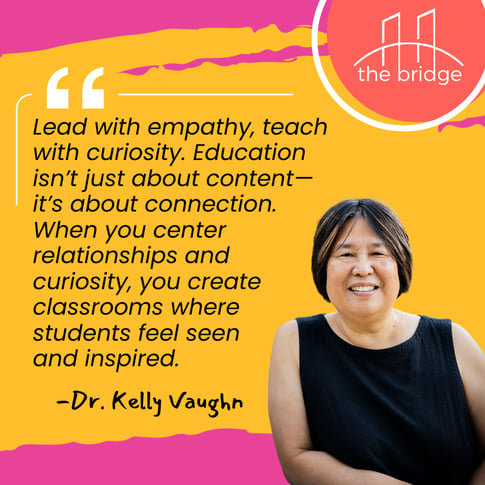
Dr. Kelly Vaughn is the Dean of the School of Education at Notre Dame de Namur University, where she leads with a vision for equity, innovation, and collaboration. Her work centers on building transformative partnerships—such as residency pathways for special education and graduate programs with local districts—while championing faculty development and cutting-edge practices like AI integration and social-emotional learning.
A lifelong educator and mentor, Kelly believes in the power of community and bold ideas to shape the future of teaching. She’s passionate about lifting others up, creating spaces for reflection, and helping educators thrive through both the triumphs and the challenges of the profession. When she’s not advancing initiatives in higher education, Kelly invests in preparing the next generation of teachers to lead with empathy, curiosity, and resilience.
Key Takeaways
- Leadership in education is about preserving dignity and belonging—content and credentials matter, but relationships are what truly sustain learning and growth.
- Kelly shares how a middle school principal’s advocacy after a racist and traumatic incident changed her life, showing her that school can be a place of safety and deep human care.
- Create intentional moments that honor students’ identities and strengths—small, visible acts of belonging can shape how learners see themselves for years to come.
- Belonging and mentorship as catalysts for long-term growth, reminding us that education is a shared journey and that we never cross the bridge alone.
Resources & Mentions
Notre Dame de Namur University School of Education
Transcript
Cate Tolnai: All right, welcome Kelly to The Bridge. It's wonderful to see you and I shared this earlier, but I'll share it again, that, you are the guest on our 26th episode, which is the bookend of The Bridge
And, it was a, it was intended to be a 26th episode, limited series. And so I'm so lucky to end with someone that means so much to me personally and professionally, which is you. Thanks. so thank you for being with us and if you wanna introduce. a little bit about yourself and, what you do in education.
and then we can go from there.
Kelly Vaughn: Okay, great. So I am Kelly and I currently serve as the permanent dean for the School of Education at Nord Dam Dier University. I've been on this job for two weeks. Prior to that, I have been the interim dean, at the same institution for a year and a half. Prior to that, I have been a, assistant, associate and then finally a tenured professor at the same institution that took about 15 or so years.
And then, prior to that, been a public school teacher and primarily teaching middle school math. For about 10 years in mill pedi, LA Unified, and then most recently in Sunnyvale school District.
Yeah.
Cate Tolnai: So what is it, you have, you talked so openly and beautifully about your own story around identity and family and culture, and so I wondered if you wanted to just frame some of this conversation with elements of your story that, you think have really shaped you to be the leader that you are.
Kelly Vaughn: Thank you. Yeah. again, I've been a firm believer for a long time about teaching to the whole child. And teaching, just preserving the dignity, of each learner, rather than focusing on our expertise or our content. And that, stemmed from my own experiences as a middle school teacher.
My, middle school student. Myself. I was live, I was part of an immigrant family. my, we were the only Asian family. in our neighborhood and one of several, in our elementary and then our middle school, there was increasingly a little bit more But we were definitely in the minority and very not well understood.
So encountered a lot of discrimination as a young person. And, what was difficult, and I'll be frank here, is that I was in a, My parents were separated and I was in the care with my siblings, in the care of my mom, who Later was diagnosed with, paranoid schizophrenia. And so it led to a lot of misunderstanding and isolation with the community.
In the neighborhood and as well as in the school. Yeah. And a particularly painful time was after an argument, a fight that I had with my mom.
I was actually thrown out in the backyard, to serve my time. And it was, at that same time where, neighborhood kids, teenagers, vandalized our home.
And, it was very graphic. They threw, ketchup and oil and they, wrote racial slurs on the driveway. Saying Go home. Go home, nips. And it was, it was a very, very traumatic experience as an 11, 12-year-old.
Cate Tolnai: Yeah.
Kelly Vaughn: So the next day I did what. I could only can think of, in my mind, was to go to the principal's office and to tell, the principal, Mr.
Taylor what had happened and. At the very least was just a way to share my, my experience. I did not expect what he did. He became such a big advocate for my, me and my family. He went and searched for those perpetrators that did the vandalism and had them prosecuted with the wow, with the support of the local law enforcement.
So they had to make it up with a misdemeanor community service. And then he continually checked on me, my mother and my father, and continued to be a friend for the family checking in on me and my siblings as we went through that middle school. And that person has really opened my eyes to say, wow, school is more than just a place where you learn, but it's a place where you can feel safe.
And a place where, you as a teacher, as an educator, you have, you could, be that advocate for other, young people. So that's where I, had the seeds from and I remember very well when I went into teaching substitute teacher and then had my own, wonderful experience. Where I got to advocate for other students, and that propelled me into really getting into the teaching credential.
And I used to say that, I really teach and learn from people. And the vehicle, which I do it is math because that's the credential part, but it's not what identifies me as an educator.
Cate Tolnai: Yeah. That's so interesting. I think that's such a balanced way of looking at our role in the classroom and on campuses because we can get overwhelmed with content and we can get overwhelmed with standards and expectations and, overwhelm can lead to burnout, can lead to leaving the profession.
And you and I both share a deep passion for educating educators. And, ensuring that their journeys as students, are as inclusive and supportive as possible so that they can then replicate that type of environment when they're in the classroom. And I wonder if there, is a time. Where you as a teacher or maybe as a dean or maybe as higher ed, like a time as a professional where you had an opportunity to guide a learner through that journey.
and how did you do it? How do you get students to understand the importance of community in their classrooms?
Kelly Vaughn: Yeah, so I, that's a great question. I think when I hearken back to, my teaching years is, I. Having not only those moments where I can speak to the whole class about their value, their worth, I used to say, I, had an ELD math class, and I think someone made a comment that, oh, this is like a stupid class.
And I said, no, You guys are talented.
Cate Tolnai: Oh, superpower class, right?
Kelly Vaughn: Do you understand that? You have something that is unique and unfortunately our system, our school system puts a labeling act that Yeah. makes it like. The dumb class, but in reality, you guys have multiple languages that you're fluent in.
Cate Tolnai: Gosh.
Kelly Vaughn: And that is a gift and that is a talent. And I want you guys to be aware of that. So I, have these moments where I seize upon that and I speak from a different, aspect, a reality that they can be reminded of. I always like to think creatively too. my middle school years, I would have my students, the first assignment that we would have is for them to paint the windows.
I did that.
Cate Tolnai: Oh my gosh, how fun. Were they actually painting on windows?
Kelly Vaughn: Yes, they were. Oh. yeah. The school administration wasn't happy about that. But we, but they were, but they would, wash 'em off at, at the end of the year. Yeah. And we'd do it again for the new class. And, I had
Cate Tolnai: Oh, cool.
Kelly Vaughn: These big windows at, palms Middle School in la and then again at Columbia Middle School in Sunnyvale. And I said, wow, this is, a great place. I think of stained glass windows. Yeah. And the purpose of it was I wanted students to basically put their identity on that to be a reminder for the whole year of who they are, not only as themselves, but as a important member of this community.
And of course we gotta tie it into math, so I would always have a math follow up. But the important thing was they were recognized. They are part of this community. So I did that as, as a practice and I think there were moments of that where I wanted to guide, students. You know what's so interesting?
About. 10 years ago I was doing, a visit to a school and I came across, it was, where is it? I think it was JLS Middle school in Palo Alto. Okay. And a person reached out to me and says, I don't know if you remembered me, Mrs. Vaughn. And when someone says, Mrs. Vaughn, it's from those teaching days.
Seriously. Not like Dr. Vaughn or Kelly, Mrs. Vaughn. I said, she said, I was your student back at middle school and you believed in me even though I had, a learning, difficulty that you encouraged me. And because of that, I stuck with it. I don't have a college degree yet. I want to, but you made it.
A safe place that I always wanted to stick around schools. And so it's like a full circle. Yeah. So now work in the office staff at JLS.
Cate Tolnai: Wow. So how does that then translate up to your current position where you're working with faculty that are leading the charge with, students slash teacher candidates?
Kelly Vaughn: Yeah. So it's really to expand that network. That's what I encourage my faculty to do.
Cate Tolnai: Yeah.
Kelly Vaughn: And to think creatively to kinda reach that expanse. So it's not only for our current traditional, student teachers, but intern teachers that perhaps have backgrounds of being a single parent and trying to juggle different jobs.
It's also meeting for working. Adults that work as classified employees that always wanted to be a teacher but didn't know how. Or, adults that wanted to be in the teaching profession, but don't even have a college degree. How can we expand our network to include them into the fold and to think about them and to, in many ways advocate for them.
Cate Tolnai: Yeah. It just reminds me of, your. Of your phrase that you've used, which is Embrace the mess. That and it's very similar to why my mantra, which is it's not pretty, it's beautiful. And that driving force that we see, like it's not about the product, it's about the process. I think both of those sentiments speak to that.
and so as you've been leading this charge at, your, at Notre Dame DeMar University over the last decade or two, how have you lived out the beautiful side of the mess?
Kelly Vaughn: Yes. I have to remind myself to not only embrace the messiness, but also to embrace and celebrate the failures.
Cate Tolnai: Oh yeah.
Kelly Vaughn: Yeah. Because that's the, growth. And, I would say the last year and a half. Looking at more recently, there's been a lot of beautiful messes this past year and a half. Yeah. Everything from, one of the big things was we had been an in-person, exclusively in-person graduate program until 2024 when I led the charge and says, Hey everyone, our current, student teaching population, our adult population, we cannot be not only a four year institution, we have to think. progressively to meet where our current working adult learners are at.
And they by far, by data shows that they much rather prefer an online modality for their coursework than in-person.
So I played the heaviest by May, 2025. With full endorsement from the board of trustees, we're gonna become online. And I think, during those really messy times when there were people, who were very angry and upset. I learned some things. I didn't have to have the last word.
I would let them have the last word. I would state the situation, but I'd let them have the last word.
I always followed up. with that, because there's a time to have meetings when there's all sorts of issues, but just to stay focused on that particular key topic and then save what other things that are on there for another time
That and trust that those processes will take care. In due time that I don't need to fit and cram everything in a meeting, especially when there are some very strong emotions involved.
Cate Tolnai: Which, in 2025 includes innovation and it includes joy and, social emotional learning. And it includes, AI and And there's so many different. Directions that you've invited us as your faculty. Which side note, I do work with Kelly. I don't even say that I, Kelly, is my dean and I'm her adjunct faculty member. And, hence why this conversation means quite so much to me. I've been a part of this journey and it's, really been, I'm sure there's tons of it I don't see. But from the perspective of an adjunct faculty member that has been, that was brought into, the beautiful mess that it is and continues to be because when we're doing, we're changing, when we're stretching, when we're trying new things, it's messy.
There is, there's still, there continues to be such a thread of, shared vision and shared purpose on our team. And I think that in large part, comes from the way that you, framed it, which I wasn't there for that part, but the way that you framed it and the way that you continue to frame it.
And I think the consistency in the way you show up and the way that you continue to grow the team, Which kinda leads me to the next point, which is you are such a connected, you are such a connector and a connected human. And we met because of a random thing that I posted on LinkedIn about a year ago, and I got this DM from.
Some dean of some school vet in Northern California, and she seems really amazing and she wants to talk to me and I'm like, sure. Let's talk. And fast forward a year later, we're recording this podcast talking about, all the, celebrating all the change that's occurred. And so what is it that drives you to be a connector?
Kelly Vaughn: I think it's the essence of continually building that community.
again, if I go back in time and how much I was so devoid of community until my young adulthood and that spark of that community building was started with my principal, with Mr. Taylor, who, formed it in the way of checking in with us.
And I think I take after my father in that I'm an extrovert and, I like my father. He had good intent of others, so expect so to, to know for the good of others, and I think I carry that legacy on.
to, throughout my teaching career and even now as an extension of that, I love to listen to other people's story.
it's actually less comfortable for me to just talk about myself, but I do like to listen to others. And always thinking in the back of my head about their, what. They say how that can be connected, to what other people do. To expand that community ultimately for that person. but in a way that I can be part of it is very exciting.
Cate Tolnai: yeah. And you've been, you're incredibly generous with your time and I'm very curious how you, like logistically how do you manage all the hats that you wear? if you. If, there's someone listening and they're like, oh gosh, I've always wanted to, I've always thought about higher ed.
Or I've always what would that actually look like? what does it look like to be on faculty and in higher education and then eventually move into leadership? how do you balance everything?
Kelly Vaughn: Great question. And, it's probably still a question in progress or an answer in progress.
Cate Tolnai: Sure.
Kelly Vaughn: but I think. This, taking this on does not come without its cost.
And it's something that honestly, Cate, I've put out or put off for a long, time. when I started off in my teaching, that same wonderful, former principal, Mr. Taylor became a superintendent, assistant associate at Oakland Unified.
And he asked me back then, Kelly, it looks like you're starting in and you have great potential. what do you think about starting in a, pathway program to get your admin credential and be here at Oakland?
Cate Tolnai: Wow.
Kelly Vaughn: And I, back then, so that was back then.
Cate Tolnai: So you had someone believe in you like that?
That's incredible.
Kelly Vaughn: Yeah, and I, back then I said I can't because. I understand the cost of what it means to be a leader. you're the first one at the school site. You're the last one to leave. You're always on call. and I was just married and my priority was my spouse, and then later on my children.
And so I have said no to a lot of things along the way.
and this particular position right now. Was almost not gonna happen.
If it hadn't been for, serendip kind of events that happened in the month or the months of March and April of 2024 that kicked it into place, a failed search, for a dean, a.
A crazy idea about, dividing the dean work to other faculty, unions saying, no, it should really be one person, and Kelly, you should be that person.
Cate Tolnai: Wow.
Kelly Vaughn: And then a consultant saying, yeah, you should be that person. And I, really actually said no that whole month, so I was not interested in being a, dean.
And I think what took it was having a great insight. Looking at my kids. And at that time, I've got two kids, one that's about ready to finish high school and the other one that's about ready to finish middle school.
And it seemed you know what, this might be the season.
Because they're really growing in their independent skills.
I used to volunteer at my kids' elementary, middle school, and. I loved it. It was the closest scene of teaching and it, dawned on me that would be coming to an end.
And so perhaps my serving could be placed elsewhere, and that's what led me to rethink. About, okay. Maybe I will go for the interim, Dean, if you need it.
And here we are. Here we are
18 months later.
Cate Tolnai: But that story is so full of self-awareness. just like you seem like this was not a, a decision made without deep thought and impact and readiness and all of that, which is, I, think exactly how you lead. And I think oftentimes, If, a leader doesn't, wear all those details on their sleeves and make all of that journey transparent, there are some people that would assume that those steps aren't happening. But I think for me. knowing you, even just the short time we've worked together, I know that you're going through the, that deep level of processing and thinking of all the different people involved and the impact of all of these different decisions and what's gonna happen at the end of the day and why are we doing this?
And I, I hope for educators out there, they hear in this, these stories that, That you never, know that, you never know what might come of an opportunity that at first maybe didn't seem like the right fit, but trust your instinct. if it's right, it will come back. And it seems like that's exactly what has happened for you.
Kelly Vaughn: Yeah. It is. and perhaps that's why I was, not knowing that stuck around for 15 plus years
Cate Tolnai: Yeah.
Kelly Vaughn: Is what could happen.
Cate Tolnai: Yeah.
Kelly Vaughn: but yeah, I was, actually looking forward, Cate, of thinking, maybe before retirement I'll go back into the classroom. Oh my gosh. And my, my, my working years back as a full-time teacher or even part-time and part-time teacher educator, I actually was thinking about that.
Then this came along and I think it was just that timing of that this is your time to lead. And I think, it was to be, okay with that because I had gone from, a cycle of. being isolated and then coming up and then having this false sense of expectation that, hey, I can, be the, leader and the decision maker for everything.
And then having those, wonderful failures to show no, maybe, not the way you expected, and then coming down and just learning. while not in leadership, but those are the very seeds that took me up.
Cate Tolnai: Fascinating.
Kelly Vaughn: In the
least, expected way. And so I think it's me reflecting on those moments and yes, you're right, Cate is to be aware.
looking back as valuable lessons for, Coming up and how I've been changed along the way. because I think one of the things that I wanted to make sure in taking on this position is that ultimately I learned so much about this to help others and not what I can do out of my. Out of my natural giftedness, but it's really more what I can learn.
And I think when I have that open mind, that's where I am much more, courageous or more open to take those bold steps of innovation. because in a way I don't feel like I have anything to lose. I don't feel like my reputation or my. My job is on the line. I'm not afraid if, if I get pulled down from the dean, it's not about me.
It's about the community and my part of it. What can I learn to help strengthen this or what can I do as well?
Yeah.
Cate Tolnai: So beautiful. I'll end with this last question, which is, if you could go back and give yourself any advice as a aspiring. Educator or even an aspiring higher ed faculty member or an aspiring leader in higher ed, what advice would you give yourself?
Kelly Vaughn: the advice that I would give to my younger self is to really enjoy. Listen and take in the moments that you have in your community, whether it is your middle school classroom, your fellow classroom with other doctoral students, or, your own classes when you're teaching graduate level classes, that you are as much of a learner as you are a teacher, and, not to worry about.
Tomorrow or next year. But to really, embrace and seize the moment of today, knowing that you're gonna take in the kernels of wise experience that will plant the seeds for tomorrow.
Because when I start worrying about tomorrow, that's when things can start to crumble.
Cate Tolnai: Yeah. Yeah. And spiral and spin.
Yeah. Kelly, you are wonderful. Thank you for, those sound bites at the end too. I'm just like processing that. I'm glad it's all recorded and captured for the world to hear. I, thank you so much for the opportunities you've carved out for me and the friendship and advice and mentorship that you've offered me over the last year.
And, it, is something I can't wait to pay forward when the time comes to others. but for now, I just thank you for being on The Bridge and, until next time.
Kelly Vaughn: Thank you. All right.
Cate Tolnai: All right.